
A laboratory refrigerator does quiet, unglamorous work, and the rest of the cold chain is no different. Samples, reagents, standards, cultures and clinical specimens all sit in cabinets that need to hold a narrow temperature band, year after year, with very little attention. Because they usually manage it, cold storage rarely makes anyone’s priority list. This guide covers what to look for when you specify cold storage and incubation, how to validate that it performs as claimed, and what keeps it running.
The Cost of a Single Temperature Excursion
The repair invoice is the smallest number involved.
Start with the contents. Patient samples, cell lines, and reference materials are often irreplaceable. Then add the investigation: reviewing logs, assessing affected material, and documenting all of it. Accredited laboratories must record the excursion and the corrective action, and an auditor will ask about sensor placement and alarm response as much as about the failure itself.
Then add the work that stops while you deal with it.
One excursion in a laboratory refrigerator holding clinical samples can cost more than the unit did. That is the arithmetic behind everything below.
The Specifications That Actually Predict Performance
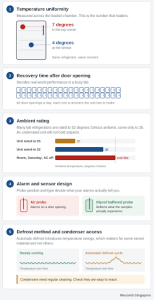
When you compare any refrigerator for laboratory storage, setpoint accuracy is usually the first number you see. On its own, it tells you surprisingly little about how the unit will perform in your lab. The five specifications below give you a far better picture, and they are worth checking before you buy.
Refrigerators, Freezers and Ultra-Low Storage Compared
-
2 to 8 degrees Celsius.
Pharmacy, blood bank, and general sample storage. When choosing a refrigerator for laboratory use in this band, look for forced air circulation, buffered probes, and lockable doors where access is controlled. Most lab refrigerators in service sit here.
-
Minus 20 to minus 30 degrees Celsius.
Choose manual defrost for anything sensitive to cycling. Automatic defrost is convenient but warms the chamber briefly on every cycle.
-
Minus 80 degrees Celsius.
Ultra low temperature freezers use cascade refrigeration and reject significant heat into the room. Two things get missed at planning stage: the cooling load added to the lab, and whether the electrical supply and backup arrangement can carry it. Vacuum insulated models cut footprint and energy use at higher cost.
-
Below minus 150 degrees Celsius.
Liquid nitrogen storage, with its own handling, oxygen monitoring, and safety requirements.
Match the technology to storage duration and sample value, not to the lowest temperature available.
Incubator Laboratory Equipment – What to Check Before Buying
For a CO2 lab incubator, sensor type is the first question. Infrared sensors are unaffected by humidity and recover quickly after the door opens. Thermal conductivity sensors cost less but need time to stabilise, which shows up in cultures.
Recovery time for temperature, CO2, and humidity after a 30 second door opening. Compare lab incubator figures under the same test conditions.
Contamination control. High temperature decontamination cycles, copper interiors, and chamber design without traps and seams. Ask how long a cycle takes, because the unit is offline throughout.
Uniformity across all shelves when fully loaded, not at the centre point.
Gas supply. Cylinder changeover systems stop a lab incubator running out of CO2 over a weekend. This is one of the more common avoidable failures we see.
Documentation. Any incubator laboratory equipment used for accredited or regulated work needs traceable calibration and records your quality system can accept.
Building a Monitoring and Maintenance Routine
Continuous monitoring independent of the unit’s own controller is the baseline. If the controller fails, its display fails with it.
Alarms need to reach a person, not a panel in an empty corridor. Set escalation paths, test them quarterly, and confirm who responds at 2am on a public holiday. Review logs weekly, not only after an incident, because slow drift shows up long before it becomes an excursion.
For maintenance, clean condensers on a schedule, check gaskets and hinges, verify alarm function, and calibrate to traceable standards at set intervals. Keep an asset register listing every refrigerator for laboratory storage, every freezer, and every incubator, with location, contents, service dates, and calibration history. It saves days during an audit.
Planning for Failure – Backup Power, Spares and Response Times
Every unit holding critical material needs a written answer to one question: what happens if this stops right now?
That answer covers essential power supply, backup CO2 or liquid nitrogen injection for ultra low freezers, and spare capacity to transfer contents into. Decide where material goes before you need to move it, and make sure someone on site knows.
Incubator laboratory equipment needs the same plan: a gas changeover arrangement and a written route for moving cultures.
Then check the support side. Which spares are held in Singapore, what the response commitment is, and whether engineers are available after hours. A compressor for a laboratory refrigerator sourced from overseas turns a two day repair into a three week problem.
Review Your Lab’s Cold Chain
If you are not certain how your cold storage would perform in the next failure, that is the review worth doing this quarter. Mecomb supplies, installs, commissions, and calibrates laboratory refrigeration, incubators, and monitoring systems for research, healthcare, and industrial laboratories, backed by engineers based here.
See our Scientific Solutions capabilities, or contact us to arrange a review of your cold chain.
Speak to the Mecomb team
Phone: +65 8715 7216
Email: sales.msl@sime.com
Contact page: Contact Mecomb Singapore | Engineering Support – https://mecomb.com/contact-us/
Talk to Mecomb about specifying, monitoring and maintaining every laboratory refrigerator, freezer and incubator in your facility.