
Anyone shopping for an air compressor supplier in Singapore learns the same lesson early: the machine on the quotation is the cheapest part of the decision. Compressed air is often called the fourth utility, alongside electricity, water and gas, and it is usually the most expensive of the four to produce. A poorly matched compressor seldom fails outright. It simply burns power and pushes moisture into equipment that was never built to handle it.
What Is an Industrial Air Compressor?
An industrial air compressor takes ambient air, reduces its volume, and delivers it at higher pressure so it can do useful work. That work might be driving a pneumatic actuator, powering a hand tool, conveying powder, or holding a control valve in position.
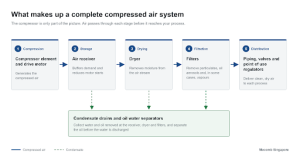
Two numbers define the duty. Flow, usually stated in litres per second, cubic metres per minute, or cubic feet per minute, tells you how much air the system delivers. Pressure, stated in bar gauge, tells you how hard it pushes. Get either wrong and you either starve production or burn money generating air nobody uses.
A third number matters just as much for any industrial air compressor Singapore sites depend on. ISO 8573-1 classifies compressed air by particulate, water, and oil content, and the class you need depends entirely on what the air touches downstream.
Common Uses of Air Compressors in Singapore
The industrial base here is compact, varied, and demanding, and compressed air shows up across almost all of it.
| Sector | Key requirement | Typical uses | Why it matters |
| Petrochemical and process plants
Jurong Island and the western industrial corridor |
Safety critical | Instrument air for control valves and actuators | If instrument air fails, valves move to their fail position and the unit trips. |
| Pharmaceutical, biologics, and medical | Oil free | Product and packaging contact, medical air | Oil free air is standard where the air contacts product or packaging, and hospitals run separate medical air systems to their own specification. Documentation and validation matter as much as the hardware. |
| Semiconductor and precision engineering | Clean, dry, stable | Pick and place equipment, air bearings, automated handling | Moisture or oil carryover here does not just cause downtime, it causes scrap. |
| Food, beverage, and packaging | Food contact quality | Blowing, filling, capping, pneumatic conveying | Food contact applications carry their own air quality expectations. |
| Marine and shipyards
Tuas and Sembawang |
Heavy duty | Tools, blasting, painting, engine starting air | Yards in Tuas and Sembawang need an air compressor Singapore crews can run hard all day. Portable units often work alongside fixed installations. |
| Buildings and facilities | Support systems | Laboratory benches, workshop tools, water treatment, pneumatic controls | Pneumatic controls are still part of older building management installations. |
| General manufacturing | Everyday production | Tooling, clamping, ejection, cleaning | Metal fabrication, plastics, electronics assembly, and logistics automation all rely on it across the production floor. |
Types of Industrial Air Compressors Available
Reciprocating, or piston, compressors.
A piston compresses air inside a cylinder. These handle high pressures well, cost less to buy, and suit intermittent duty such as a workshop or a small maintenance bay. They run hotter and noisier than screw machines and are less suited to continuous operation.
Oil injected rotary screw compressors.
Two meshing rotors compress air continuously while oil lubricates, seals, and cools the element. This is the workhorse of local industry. Screw machines run reliably at high duty cycles, offer good efficiency at full load, and are well supported for parts and service. The oil is separated downstream, but trace carryover is always present, which rules them out for some applications unless extra treatment is fitted.
Oil free rotary screw compressors.
The compression chamber has no lubricant, so the air leaving the machine carries no compressor oil. These cost more up front and need careful maintenance, but for pharmaceutical, food contact, electronics, and medical work they remove a contamination risk entirely rather than managing it.
Scroll compressors.
Two spiral elements compress air with very low noise and vibration. They suit laboratories, dental and medical rooms, and smaller clean air demands where the machine sits close to people.
Centrifugal compressors.
A dynamic machine that accelerates air through an impeller. These are efficient at very large, steady flows, which makes them a fit for major process plants rather than typical factories.
Fixed speed against variable speed drive.
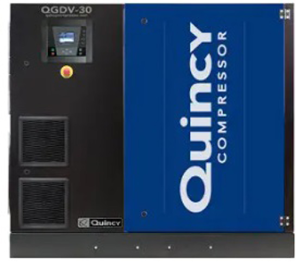
A fixed speed machine runs at one speed and unloads when demand drops, and unloaded running still consumes energy. A variable speed drive matches motor speed to actual demand. Where load fluctuates across shifts, VSD usually pays back the price premium through lower energy use and steadier system pressure. Where demand is flat and near full load, a well selected fixed speed industrial air compressor Singapore plants run continuously can still be the better economic choice.
How to Choose the Right Air Compressor for Your Operation
Before looking at any catalogue, we usually suggest starting with measurement. The sizing mistake we see most often is adding up the nameplate consumption of every pneumatic device on site and buying to that total. Real plants rarely run everything at once, so the result tends to be an oversized machine that short cycles, wears faster, and costs more to run than it should. The flowchart below walks through the decisions we recommend making, in order.
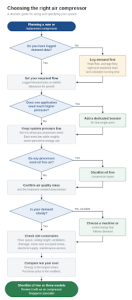
Answer those six questions honestly and the shortlist usually narrows to two or three models. At that point, it helps to bring them to an air compressor Singapore specialist who will test your assumptions with you, rather than simply quote what you asked for.
Factors That Affect Air Compressor Performance
Climate is the first factor and the one most often underestimated. Ambient temperatures around 30 degrees Celsius with relative humidity above 80 percent mean the machine draws in warm, wet air all year. Warm air is less dense, so it works harder for the same delivered volume. Wet air means a heavy condensate load, which puts real pressure on dryers, drains, and separators. A dryer sized for a temperate climate will struggle here, which is why Singapore air compressor installations often fail on air treatment long before the compressor itself gives trouble.
Other factors worth checking on any site:
Compressor room ventilation.
Machines reject a lot of heat. A hot, poorly ventilated room raises inlet temperature, cuts capacity, and shortens component life. That heat can also be recovered for useful purposes rather than dumped.
Leaks.
An untreated system commonly loses twenty to thirty percent of generated air through leaks. Fittings, quick couplers, hoses, and condensate drains are the usual sources. Leak surveys are one of the highest return maintenance activities available.
Pressure drop.
Undersized pipe, sharp bends, clogged filters, and undersized regulators all force the compressor to work at a higher discharge pressure than the application needs.
Artificial demand.
Running the system above required pressure increases consumption at every open outlet and every leak.
Receiver capacity.
Too little storage causes short cycling and unstable pressure. Adequate storage lets the machine run in a stable, efficient pattern.
Control strategy.
Where several compressors share a header, a proper sequencing controller keeps the right combination running instead of leaving machines part loaded.
Maintenance discipline.
Filters, separators, oil, coolers, and drains all have service intervals. Missing them costs efficiency long before it causes a breakdown.
What to Look for in an Air Compressor Supplier in Singapore
The machine is the easy part. Almost anyone can quote equipment. Look instead at what surrounds it, because the difference between one air compressor supplier Singapore quotation and another is rarely the compressor itself.
Engineering capability before the sale.
Does the vendor measure your demand and ask about your process, or simply match a model to a budget?
Installation and commissioning.
Piping layout, room ventilation, drainage, electrical connection, and dryer selection all decide whether the installed system performs the way the datasheet promises.
Compliance support.
Air receivers used in local workplaces fall under pressure vessel requirements administered through the Workplace Safety and Health framework, including periodic examination by an authorised examiner. An air compressor supplier in Singapore who handles this routinely saves you time and avoids surprises during inspection.
Spare parts held locally.
Ask what is on the shelf here and what has to be air freighted. The answer tells you how long a breakdown will actually last. Your air compressor Singapore supplier should be able to give you that list without checking.
Depth of the service team.
Ask how many qualified engineers the company has, what their response commitment is, and whether they can support after hours.
Range beyond the compressor.
Dryers, filtration, receivers, silencers, ventilation fans, and condensate treatment sit in the same system. An air compressor supplier Singapore operators can also call for fans, silencers, and HVAC removes the coordination burden from your team.
Track record in your sector.
A pharmaceutical clean air installation and a shipyard tool air system are different problems. Ask for relevant references.
The Importance of Local Technical and After-Sales Support
A compressor is one of the few assets where the cost of failure is measured in whole production lines. When it stops, the question is not what it cost to buy. It is how quickly someone qualified can be on site with the right part.
Local support changes several things at once. Planned maintenance is scheduled around your production calendar rather than a service partner’s travel plans. Common wear parts are on the shelf instead of in transit. Engineers who have seen your installation before arrive already knowing the layout, the control settings, and the history of the machine. This is the practical argument for choosing an air compressor supplier in Singapore with its own service organisation rather than a reseller who subcontracts the work.
Good after sales support also improves the system over time. Service visits produce data: running hours, load and unload ratios, pressure trends, condensate volumes. Reviewed properly, that data points to leaks, control problems, and sizing mismatches long before they become failures. Operator training is part of the same picture, because the people working near the machine every day usually notice a change first.
A capable air compressor Singapore supplier is not only a repair function. It is how a compressed air system stays as efficient in year eight as it was in year one.
Why Choose Mecomb for Industrial Air Compressor Solutions
Since 1953, Mecomb has supported Southeast Asia’s industries with engineering products and the technical service to keep them working. As part of Sime Darby Industrial, we combine internationally recognised principal brands with engineering teams based here, familiar with local conditions, local compliance requirements, and the realities of running plant in a tropical climate.
We work as an air compressor supplier Singapore industries can treat as a long term partner rather than a one time vendor. We supply, install, commission, and service complete systems rather than standalone machines. Our industrial and building systems capability covers compressors, fans, silencers, and HVAC equipment, so ventilation, noise, and heat questions are handled alongside the air package itself. Where a site also runs pumps, dosing systems, fuel management, or laboratory equipment, the same organisation supports those too.
How we work is guided by TORCH, the values our people put forward themselves: teamwork, openness, respect, commitment, and honesty. In practice that means clear advice on what your operation actually needs, straight answers about what a system will and will not do, and a service relationship built for the long term.
Speak to Mecomb About Your Air Compressor Requirements
If you are specifying a new system, replacing ageing equipment, or trying to work out why your energy costs keep climbing, our engineers can help you assess the demand profile and select equipment suited to your process and your site.
Talk to Mecomb, an air compressor supplier in Singapore with more than seventy years of engineering experience behind it, and arrange a discussion with our industrial systems team.
See our Compressor Solutions capabilities, or contact us to arrange a site assessment.
Speak to the Mecomb team
Phone: +65 8715 7216
Email: sales.msl@sime.com
Contact page: Contact Mecomb Singapore | Engineering Support – https://mecomb.com/contact-us/
Contact the Mecomb team to arrange a site assessment and discuss what your operation actually needs from an air compressor supplier in Singapore.